
The Importance of Symbols, A Defense of Lapel Pin Nationalism
[Originally published and used here with permission by Jonathan Hansen]
Humanity has been described as homo-religiosus, meaning that we are creatures of inherent religiosity. It is not if we will worship, but what we will worship.
In a similar way, humanity is homo-symbolum. Meaning that we as humans will always inherently create symbols, tokens, signs. Every nation has a flag. Every ancient house, a crest. Every location, a sign. Every company, a logo. There is something inherent about us that creates a symbol, a sign, a token to represent belief and thought. There is something deeply written into man that makes him desire to express complex thought through symbolic imagery.
You see this expressed in certain ancient languages. Ancient Egyptian for example was a series of pictures containing meaning. I’ve heard people describe how languages like Chinese contain a distinct but similar theme. Certain characters almost look like the word they are conveying.
This is built into humanity. It is even expressed in Christianity. Christ is our Rock, the Lamb of God, our Cornerstone, and more. Christ is not in the literal sense a rock. And yet, the symbol of a rock, a cornerstone, a spotless lamb tell us deep truths about Christ. He is certain. He is what we must build our lives on. He is our perfect substitute, innocent and pure.
Perhaps this is why Christianity has always been a religion of symbols. From its earliest days the symbol of the anchor was used. A symbol of certainty in the storm. Clearly drawn from Hebrews 6:19-20 “This hope we have as an anchor of the soul, both sure and steadfast, and which enters the Presence behind the veil, where the forerunner has entered for us, even Jesus, having become High Priest forever according to the order of Melchizedek.”(Hebrews 6:19–20, NKJV)
Because of this, the anchor became a core symbol of Christian hope. But this is hardly the last symbol to be directly tied to Christianity. The most clear is the cross itself. It is THE symbol of Christianity. Through all time and in any place, the cross represents Christ and His church. And there are even numerous crosses used to symbolize various aspects of Christianity. The Jerusalem Cross, the Celtic cross, the crusaders cross, the orthodox cross, etc etc etc.
There are almost countless other symbols tied to Christianity. The Dove. The chalice. The baptismal font. The chi rho. The lion. On and on it goes. Numerous symbols all tying back to core Christian beliefs.
However, there is a problem.
We live in a disenchanted age. We have lost a sense of the magic or reality. We have lost so much of what our fathers knew so well. No longer do we feel an inherent link between the ethereal concept and flesh and blood reality.
You may expect me to say that this means we no longer use symbols. No, we still use symbols. We are homo-symbolum after all. We cannot help but use symbols. It is an inherent part of the world God has made.
No, our disenchantment has just resulted in the symbols we use being unfathomably lame and gay. Gone are the majestic stained glass windows filled with glorious glowing imagery of Christian beauty. Replacing it is a storefront door with a minimalistic, brutalist, post modern church logo of the first letter of the churches name paired with “c” for “church.” If they are feeling especially creative the letters will sit atop a blank book representing the Bible. (How ironic the book is always blank. Not even a representation of words on it. This almost encapsulates how blank we are in majesty.)
The elevated, intricately carved pulpit replaced by a tall coffee table. The clerical collar replaced by a polo shirt and jeans (my friend calls these Baptist vestments). Gone are the symbols peppering church life such as doves descending in glory, saints to be looked up to, rich light and majesty. Replacing it are arrows. So. Many. Arrows. (If I see one more church logo made of arrows I may need to be checked into a mental hospital.)
I am not trying to be too harsh on any of these churches. I literally planted a church with arrows in the logo. (Let he who is without cringe cast the first stone, right?) besides, I know so many faithful churches that are doing God’s work who have arrows in their logo. It’s not about the arrows. I am just trying to highlight that we have lost something. We have lost the majesty in our symbols.
But I am not all doom and gloom. There is a resurgent trend to recapture the glory of symbols.
Taking back glorious symbolism
Among especially young men there is a true and noble effort to recapture the enchantment of reality. And this is tangibly felt in a growing love for recapturing the symbols of our faith and our people.
It is not uncommon to hear cries of “Deus Vult” from many young Christian men. A recapturing of the ancient Christian crusader battle cry. These men adorn their lives with various historic crosses and symbols. They have them hanging on their walls, stamped on their bibles, and even on their suit lapel pins.
Why the lapel matters
This trend is most clearly seen in a virtual firestorm of young conservative Christian men adorning their suit jackets with lapel pins. (Even the suit is a sign of recapturing Christian symbols but we don’t have time for that.)
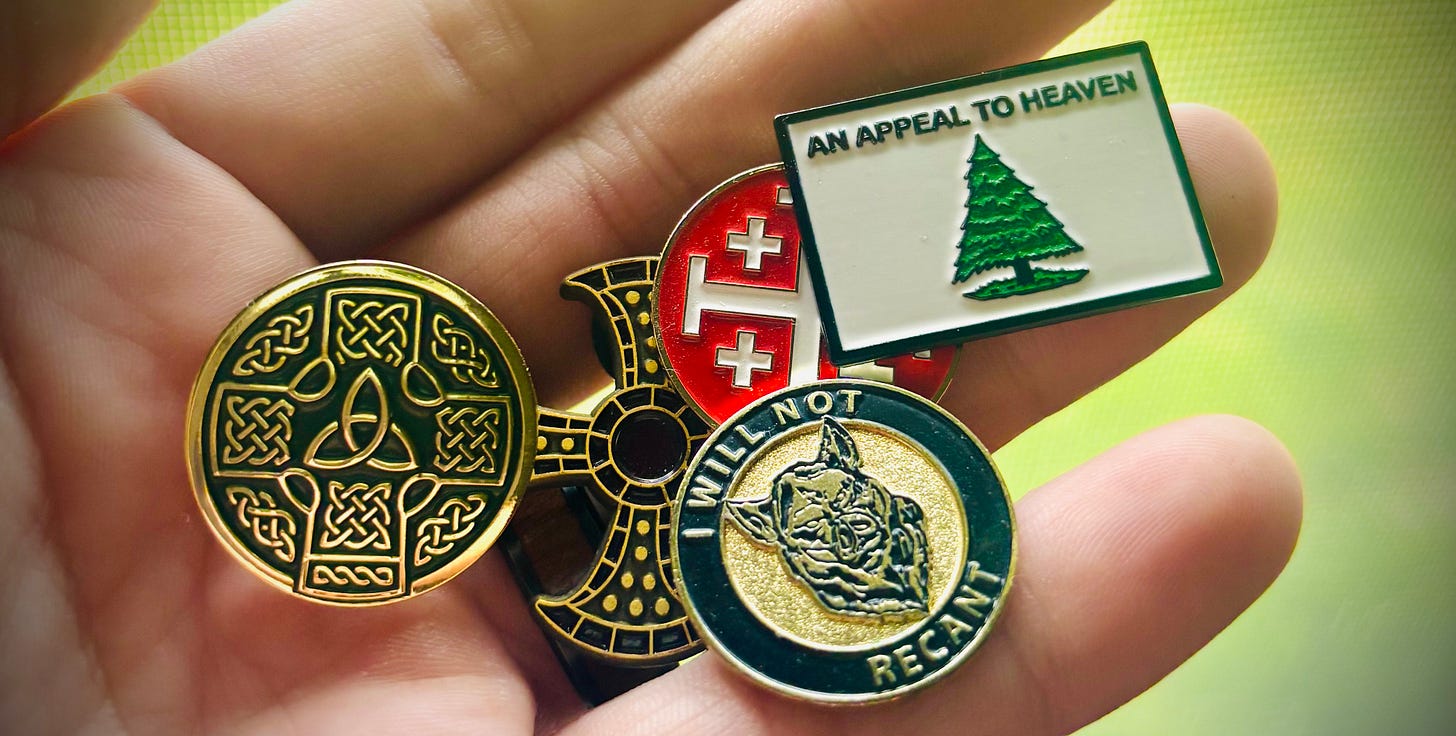
Chief contributor of this lapel pin distribution is a friend of mine, the anonymous owner of Deus Vult Lapel Pins. He has made (and is making) tons of small pins recapturing various crosses from Christian history, as well as national symbols of heritage.
There is something captivating to the Christian right about wearing a small symbol of heritage right above your heart. From the Anglo Saxon cross to the Jerusalem Cross to the “Appeal to Heaven” flag of American history. It’s not just a pin. It’s a piece of heritage.
But what exactly is so captivating about this? Why do I have a massive collection of these pins? Why did I commission a custom pin for my group of friends with a boar? Why are so many young men taking this small square inch to express these symbols?
It is because so many young men feel the disenchantment. They have been deracinated, denied any people or place. They have been hated and told they are evil simply for being men. (The sin is extra evil if they are white.) Their lives have been stripped of all glorious symbols and replaced by symbols representing our current broken, wicked, materialistic, feminized, communistic, homosexual order. So men are seeking out the ancient symbols, the rich symbols, the transcendent symbols of former ages.
They are attending high churches with gloriously rich liturgy, beautiful imagery, and majestic music. They are reading their long dead ancestors most have never even heard of. (Hello, reformation heritage books? Yes, do you have a copy of the complete works of Thomas Bradwardine?) They are wearing suits. And they are adorning those suits with small pins to state that we have a history. We have a legacy. We have symbols embodying deep truth rooted in our people, our place, our very souls.
The point of this is not to go buys pins (sure go do that), but the point is to examine what symbols are, what they communicate, and why they matter.
Symbols matter because we are creatures of symbols. We naturally represent deep things in simple pictures. I hope this trend to recapture glorious symbolism grows. I hope we lay aside the lame logos of our day and seek out the rich symbols and images of our heritage. Because the symbols we use communicate much about us.
A rich people will have rich symbols. It’s similar to how a smart man can speak on something incredibly complex. An even smarter man can speak on something complex in a way that others easily understand. But a wise man, a truly and deeply wise man, can capture an infinitely complex idea and condense it down into a few lines that the simplest man can feel in his soul. We have likely all read men like this. C.S. Lewis always comes to mind for me. He had the ability to, in a few words, capture the spirit of some of the deepest concepts.
So examine, what symbols do we use? Are they rich and filled with glory? Recapture a love of the glorious. Retake a passion for the way God created the world, filled with complexity wrapped in simplicity.
Deus Vult my friends. Go forth and image.