Cromwell Nationalism Pin - 1"
Cromwell Nationalism Pin - 1"
In stock
Couldn't load pickup availability
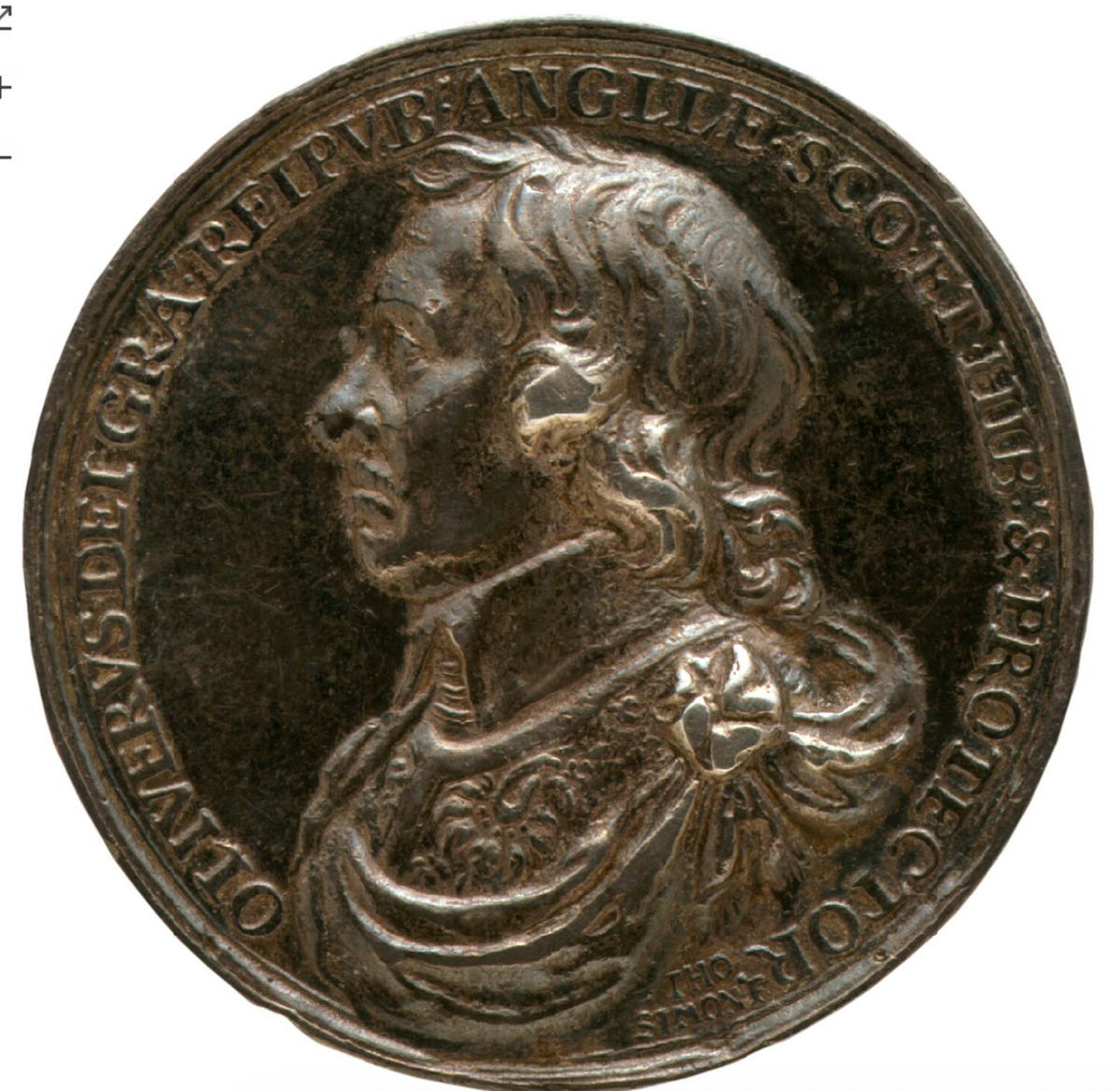
This is a 1" antiqued brass lapel pin inspired by "The Lord Protector Medal," struck to commemorate Oliver Cromwell's inauguration as Lord Protector in 1653.
The original medal was engraved by Thomas Simon, chief engraver of the Mint under the Commonwealth, whose signature appears beneath the portrait. It shows Cromwell in armor with long hair and a sash knotted at the shoulder. The Latin legend reads Olivarius Dei Gra. Reipub. Angliae Sco. et Hib. &c. Protector, "Oliver, by the Grace of God, Protector of the Commonwealth of England, Scotland, and Ireland."
Cromwell was born in 1599 to a family of minor gentry in Huntingdon. In his late thirties he experienced a profound Puritan conversion, later describing himself as having been "the chief of sinners." That faith shaped everything that followed. When civil war broke out between King Charles I and Parliament in 1642, Cromwell, a member of Parliament with no military training, raised a troop of cavalry. His disciplined, devout horsemen became known as the Ironsides, and he rose to command the cavalry of the New Model Army, winning decisive victories at Marston Moor (1644) and Naseby (1645).
After the war, Cromwell was among those who signed the death warrant of Charles I, executed in January 1649. He then led campaigns in Ireland and Scotland. His Irish campaign, including the sieges of Drogheda and Wexford, remains one of the most bitterly debated episodes in British history. At the Battle of Dunbar in 1650, as the sun rose over his outnumbered army, he is said to have cried out the words of Psalm 68: "Let God arise, let his enemies be scattered."
In December 1653, Cromwell was installed as Lord Protector under the Instrument of Government, England's first written constitution. He ruled as head of state for nearly five years. In 1657 Parliament offered him the crown. He refused it.
Cromwell died on September 3, 1658, the anniversary of his victories at Dunbar and Worcester. After the monarchy was restored in 1660, his body was exhumed and hanged at Tyburn, and his head was displayed on a pole outside Westminster Hall for decades. It was finally laid to rest in 1960 at Sidney Sussex College, Cambridge, where he had studied as a young man.
Today a bronze statue of Cromwell, Bible in one hand and sword in the other, stands outside the Houses of Parliament.
By special request from the DVLP bros.
Share